Essential Local Schema Markup Guide for SMBs
72% of local searches that lead to a store visit start with a query. Many of these searches rely on structured signals that search engines can read. For SMBs, local schema markup converts basic contact info into machine-readable facts for search engines and AI.
Structured data for small businesses is a standardized format. It describes who they are, where they are, and what they offer. The schema.org vocabulary—backed by Google, Bing, and others—enables rich snippets and knowledge panels.
Adding SEO schema for local companies is easy and low cost. JSON-LD snippets can be added to a page head or through Google Tag Manager. For SMBs, agencies like Marketing1on1 can help design and implement schema for consistency and edit your business profile on Google.
What is Local Schema Markup and Why It Matters for Small Businesses
Local schema markup helps search engines interpret business details more like people do. It labels important info such as name, address, and hours. This makes small businesses more visible online.
Small companies can apply schema.org local business types to strengthen online presence. They should make sure their website facts match their Google Business Profile.
There are three common formats: JSON-LD, microdata, and RDFa. JSON-LD is typically easiest to implement and safest for developers. It demands minimal or no HTML edits.
Microdata for SMBs works when embedded inline, but JSON-LD is better for testing tools and content management systems.
Search engines assess schema to determine eligibility for rich results and knowledge panels. They scan markup to validate that on-page content aligns. Google’s Rich Results Test helps find errors and shows possible rich features.
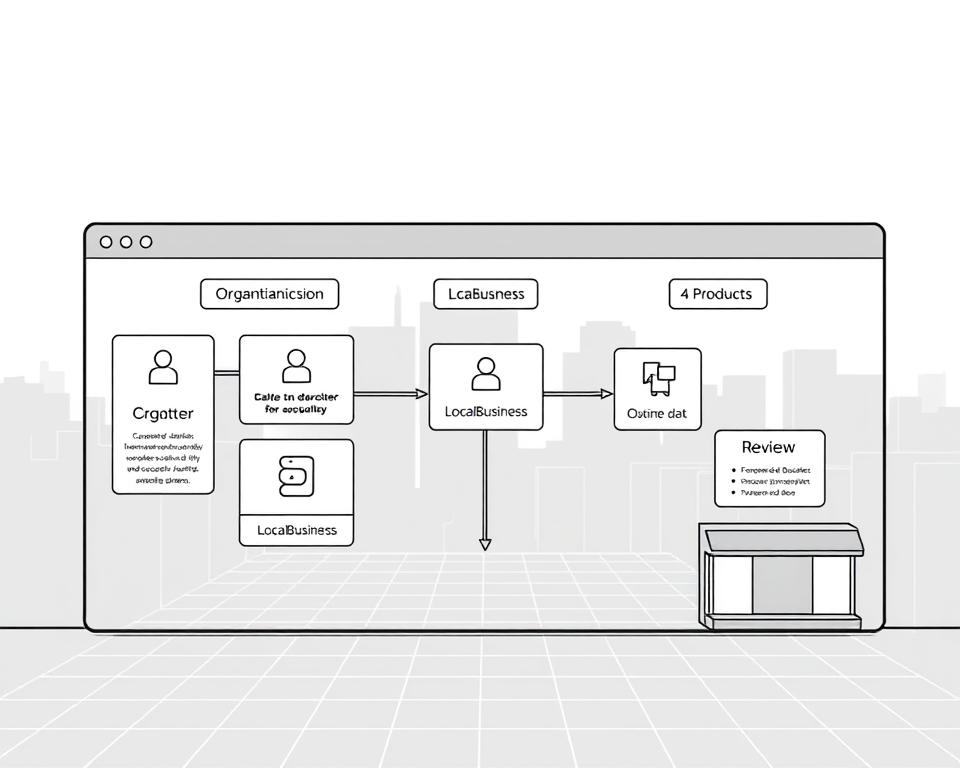
Select the most specific schema class for your business. Local Business is good for shops and clinics. It supports properties such as opening Hours and address.
Picking subtypes like Dentist or Restaurant clarifies your service category. That is stronger than relying on a generic type.
Organization is for brand-level data. It supports logo and social profile links via sameAs. Add it to the homepage and About page to assist knowledge panel creation.
WebSite and WebPage encode site-to-page relationships. WebSite can include a Search Action for site search. WebPage links content to WebSite, clarifying which pages answer which queries.
Practical tips: choose the most specific subtype, mark only visible content, and confirm schema matches citations and your Google Business Profile. These steps reduce errors and improve local search accuracy.
| Schema Type | Main Use | Important Properties |
|---|---|---|
| Local Business + subtypes | Describe physical location and offered services | name, address, opening Hours, geo, Contact Point, priceRange |
| Organization | Brand-level identity and knowledge panel signals | name, logo, sameAs, Contact Point, foundingDate |
| WebSite | Sitewide search and actions | name, url, potentially Action (Search Action) |
| WebPage | Page-level context for content and images | is PartOf, primary Image Off Page, description, breadcrumb |
Benefits of Schema for Local SEO & AI Visibility
Structured data can increase online visibility for SMBs. Local schema markup helps search engines and AI systems understand your business more clearly. This clarity can make your phone number, hours, and booking options more visible in search results.
Rich results help your listing stand out. Features like stars, FAQs, and product details grab more attention. This can lead to more clicks and visits to your website.
- Higher CTRs: Richer snippets tend to draw more clicks and increase organic traffic.
- Actionable Prompts: Cards may show CTAs—Call or Book—that drive direct conversions.
Accurate contact and location data improve local search results. SEO schema helps align business information with your Google Business Profile. That consistency helps you appear in local results more reliably.
Clearer local data helps search engines rank you better. It becomes easier for customers to find you, schedule visits, and get directions.
Structured data enables search and AI systems to return accurate answers. By adding schema for small businesses, you can be included in voice responses and answer boxes. This increases your chances of being seen by users.
AI-readiness helps shield your brand from misinformation. Clear schema reduces confusion between similar businesses. Fields like AggregateRating reinforce trust.
You can measure business outcomes. Greater visibility can translate into more calls, bookings, and sales. Adding local schema markup can make your business more visible in search results.
Small business teams should see schema as a valuable investment. Simple schema additions can lead to richer listings, better local matches, and more AI citations. Together, these effects can turn visibility into real customer actions.
Essential Schema Types SMBs Should Implement
Using appropriate structured data can improve visibility for SMBs. Begin with core identity schemas, then add types that support your site goals. This helps search and AI systems surface the right details to local customers.
Local Business Type and subtypes are crucial for local presence. Use specific types like Dentist, Plumber, or Restaurant. Provide name, url, image, telephone, and address. Add opening Hours, Geo Coordinates, and sameAs profile links.
Use Organization on the homepage and About page. It includes name, url, and an Image Object for the logo. Add sameAs to social profiles and Contact Point for sales/support. This schema helps with brand knowledge panels and SEO.
Service and Product schemas are for service and ecommerce pages. For Service, include serviceType, provider, and areaServed. For Product, include name, description, image, and offers. Appropriate Offer and aggregateRating usage can boost conversion.
Review and AggregateRating markup can improve CTR. Only markup reviews on your site. Use Review and AggregateRating to build trust without risking penalties.
Breadcrumb List helps search engines and visitors understand site hierarchy. Add Breadcrumb List sitewide in templates. FAQPage is useful for common customer questions and can enable direct-answer snippets for voice and AI assistants.
Image Object adds metadata to key visuals like storefront photos. Include url, caption, uploadDate, and dimensions. Rich image metadata supports visual search and better representation in results.
| Type | Placement | Key Properties | Priority Level |
|---|---|---|---|
| Local Business & Subtypes | Business pages, footer, contact page | name, url, image, telephone, address, opening Hours, geo, sameAs, priceRange | High |
| Organization | Homepage, About page, header | name, url, logo (Image Object), sameAs, Contact Point | High |
| Service | Service details | serviceType, provider, areaServed, offers | Medium |
| Product | Product pages, category listings | name, description, image, sku/gtin, brand, offers, aggregateRating | Medium |
| Review / AggregateRating | Product and service pages with hosted reviews | ratingValue, reviewCount, author, datePublished | Medium |
| BreadcrumbList | Sitewide templates | itemListElement: position, name, item | Medium |
| FAQPage | Help/FAQ pages | mainEntity (Question/Answer pairs) | Low |
| Image Object | Key visual assets across site | url, caption, uploadDate, width, height, contentUrl | Low |
Prioritize schema types based on your site. Begin with Local Business and Organization. Then, add Service or Product. Use Review, BreadcrumbList, FAQPage, and Image Object as supporting elements. Applied consistently, schema.org local business types and SMB microdata can yield stronger local signals.
Local Schema Markup for SMBs
Begin by adding core Local Business fields search engines expect. Include @type, name, url, image or logo, telephone, and a PostalAddress. Also, add opening Hours in a standard format like Mo-Fr 09:00-17:00. Don’t forget to include geo as Geo Coordinates with latitude and longitude.
Make sure every data point matches the Google Business Profile and major citation sources. Maintain identical NAP, hours, and geo coordinates. Use the same punctuation and abbreviations as Google Business Profile to avoid confusion.
Choose the most specific schema.org subtype for your business. For example, pick Dentist for clinics and Restaurant for eateries. This sends a clear signal to Google, Bing, and AI systems.
Link related entities using stable @id values to form a graph. Use a dedicated @id for Local Business and another for Organization if branding differs. Connect WebSite/WebPage/Product/Service entries to those @id nodes.
Markup should reflect only visible on-page content. Do not markup hidden hours or information that contradicts what users see. Refresh holiday hours and promotions promptly to avoid stale data.
When implementing, test that contact details and geo coordinates match Google Business Profile exactly. Keep state names and abbreviations consistent across citations. That reduces crawl ambiguity and increases local accuracy.
Balancing visible content with accurate markup can boost local discovery. Proper local schema markup for SMBs combined with clean microdata for SMBs improves how structured data for small businesses is consumed by search engines and AI systems.
How to Implement Local Business Schema Step by Step
Start with JSON-LD. Google recommends it, and it’s easy for small teams. Put JSON-LD blocks in the <head> of a page or use Google Tag Manager. This way, updates don’t need a developer.
Choose which entity goes on each page. Put a single Local Business entity on the homepage. Link it to an Organization entity for brand details. Include a site wide WebSite and a per-page WebPage entity.
For service pages, include one Service object per core offering. Reference the Local Business as provider. For product pages, add Product and Offer. Add aggregate Rating if reviews are present.
Use precise schema.org subtypes. For a dentist, use Dentist; for a restaurant, use Restaurant. Add sameAs social links and accurate geo/opening Hours.
Many tools can help. The Merkle Schema Markup Generator and Search Atlas Schema Generator create JSON-LD for Local Business, Service, Product, FAQ, and Breadcrumb List. Generate, insert into templates, and test before going live.
Follow these best practices:
- Ensure schema mirrors visible content and matches Google Business Profile/citations.
- Connect entities using provider and is Part Of between Local Business, Organization, WebSite, and WebPage.
- Choose precise types and include required properties listed on schema.org for local businesses.
- Use sameAs links to major listings and social channels to strengthen entity signals.
Mark up on-page content, not hidden values. This improves trust with search engines and supports SEO schema for local companies. Regularly check schema markup for SMBs to keep it current with hours, offers, and reviews.
If needed, agencies such as Marketing1on1 can assist. They support generation, templating, and deployment. This helps ensure consistent implementation across the site.
Validation, Testing, & Ongoing Maintenance
Once schema is implemented, keep it current. Use tools to validate markup and preview search appearance. This ensures your business information stays current as your offers and hours change.
Start with Google Rich Results Test to check eligibility. Then run a Schema Validator to catch mistakes. Merkle and Search Atlas can preview how your site may appear before launch.
Keep an eye on Google Search Console for any alerts about your site. Look for reports on Breadcrumbs, FAQs, and Products to find any problems. Resolve issues promptly and use revalidation to clear warnings.
Make a regular schedule for checking your site’s schema. This is crucial after CMS or theme updates. Re-test after changes to confirm everything works.
Update schema for holidays, promotions, and service-area changes. These small updates help keep your site visible and trustworthy.
Start by adding Local Business and Organization to your homepage. Then add Search Action if warranted. Next, deploy Breadcrumb List sitewide and mark up top service pages.
In the third week, add Review or Aggregate Rating to your testimonials. Tag your key images with Image Object and add Product and Offer to your main product pages. In week four, add Geo Coordinates and Contact Point to Local Business and Organization.
After making these changes, check your site again and watch for any new alerts in Search Console. That helps ensure schema is functioning correctly.
Keep an eye on your site’s performance to see how well your schema is working. Review impressions and clicks to confirm richer results attract more visitors. Use Search Console and analytics together to track changes in traffic and clicks.
Regular testing and clear documentation make managing schema for local businesses easy and efficient. That way, your site stays current and attracts more visitors.
Common Schema Mistakes & Troubleshooting Tips
Small business owners often face common schema problems that hurt their local visibility. This guide will highlight typical mistakes and offer solutions you can apply today.
Make sure schema hours, phone numbers, and addresses match what’s on your page and Google Business Profile. Any differences can confuse search engines and lower your chances of showing up in local search results. Start by making sure your Name, Address, and Phone Number (NAP) are the same everywhere.
Hidden content pitfalls
Using schema for content that’s not visible can lead to warnings or ignored data. Google wants schema to match what users can see. Remove schema for hidden content or make it visible before marking up.
Review markup mistakes
Only use schema for reviews on your own pages. Marking up external reviews (e.g., Google/Yelp) violates guidelines and risks penalties. If reviews are on other sites, link to them instead of using review schema.
Broken breadcrumbs
Breadcrumb List must mirror navigation and URL structure. Inconsistencies may trigger Search Console errors. Check your breadcrumbs after making changes to your site and fix any issues.
Use Tests to Locate Root Causes
- Use Google Rich Results Test to find missing required properties and formatting problems.
- Use the Schema Validator to check structure against schema.org types.
- Revalidate pages after template changes and confirm the sitemap reflects corrected URLs.
Repair steps to apply
- Standardize NAP across citations and update opening Hours for holidays and special dates.
- Remove or reveal any hidden markup before publishing microdata for SMBs or structured data for small businesses.
- Correct breadcrumb positions/URLs so markup matches visible navigation.
- After fixes, use Search Console’s URL Inspection and “Validate Fix” to request recheck.
Most fixes are straightforward once identified. Treat local schema markup for SMBs as part of your content workflow. Review it after each site update to avoid issues.
How SMBs Can Scale Schema Without a Developer
Small businesses can use local schema markup for SMBs without needing a developer. Start by using tools that fit your platform. WordPress plugins, Shopify apps, and tag-manager snippets can automatically generate JSON-LD when you fill in the required fields.
Using Plugins & Apps
Select trusted options such as Yoast, Schema & Structured Data for WP, or Shopify schema apps. Enter business name, address, phone, and hours accurately to avoid errors. These tools make it easy to add clean JSON-LD to your pages or use Google Tag Manager.
Copy-paste JSON-LD generators
Use Merkle and Search Atlas to generate copy-paste JSON-LD for Local Business, Service, Product, FAQ, and Breadcrumbs. Just generate the snippets, check them with the Rich Results Test, and add them to your templates or tag-manager containers. This method helps you avoid needing developers and keeps your microdata consistent.
Template-level schema for sitewide elements
Place Organization and Breadcrumb List at template level for sitewide coverage. Add Local Business, Service, and Product schemas on individual pages through CMS fields. This way, editors can update content without needing to code, keeping your SEO schema in line with your site’s structure.
Governance and workflows
Plan a schedule for updates during holidays and promotions. Test schema changes on a staging site before publishing. Maintain simple documentation guiding updates to hours, pricing, and contact details. Regular checks help ensure your visible content and microdata stay in sync.
When to hire an SEO partner
Consider hiring Marketing1on1 for audits, complex entity linking, or custom templates. They manage schema across templates, monitor in Search Console, and deliver ongoing reports. For complex sites or multi-location brands, an expert can deliver bespoke solutions.
| Task | Tool/Approach | Why it helps |
|---|---|---|
| Single-Page JSON-LD | Merkle, Search Atlas | Fast copy-paste snippets for Local Business, Service, FAQ |
| Automate Sitewide Schema | CMS template fields, theme-level code | Scale Organization and Breadcrumb List across all pages |
| Deploy without editing theme files | Google Tag Manager | Centralized snippets, easier rollback and testing |
| Maintain accuracy during updates | Content governance checklist | Keeps on-page content and microdata for SMBs in sync |
| Audits & Advanced Entities | Marketing1on1 or SEO agency | Custom templates, validation, Search Console monitoring |
Wrapping Up
Local schema markup is a practical step for SMBs. It can increase search visibility and attract more clicks. Begin with Local Business and Organization to match your Google Business Profile. That alignment helps search engines trust your listing.
Next, add structured data for small businesses like Service, Product, and Reviews. Use JSON-LD in the page head. Validate using Google Rich Results Test and a Schema Validator. Also monitor Search Console for updates and warnings.
Use tools and plugins to expand SEO efficiently. Start with Local Business and Organization. Then add Service, Product, and Review markup gradually. If needed, consider an SEO partner such as Marketing1on1.
Start now by creating and deploying Local Business and Organization schema. Validate it with Google tools. Then, add more data like Service, Product, and FAQs. These steps will increase local SEO and AI visibility.